


How to Choose and Hang a Wall Clock: Size, Height and Where It Works
We check the time on our phones now, which you might think would make the wall clock redundant. It has done the opposite. A clock on the wall has become something you choose for how it looks and how it makes a room feel, rather than a necessity, and that makes choosing the right one more interesting.
It also means the usual mistakes matter more. Here is what we look at when we help someone choose.
Start with the size of the wall, not the clock
The most common mistake is buying a clock that is too small for the space it hangs in. A 25cm clock that looks generous in the shop can disappear on a long living room wall.
As a rough guide, if the clock is hanging above a piece of furniture, such as a sideboard, console or desk, it should be somewhere between a third and a half of that furniture's width. If it hangs alone on a wall, stand back and look at the empty wall first. A clock of 40cm or more holds its own on a large, open wall. Something between 25 and 35cm suits a kitchen, a hallway or the space above a desk.

The 30cm Karlsson Jewel Wall Clock shows the principle well. Above a sideboard, with a plant and a few objects beneath it, it reads as part of a considered arrangement rather than a lone object.
Hang it lower than you think
Clocks, like artwork, are usually hung too high. For a clock on an open wall, aim for the centre of the dial to sit at around eye level, roughly 150 to 160cm from the floor. Above furniture, leave a gap of about 20 to 30cm between the top of the piece and the bottom of the clock, so the two read as a pair.
The exception is a kitchen or a hallway where people need to see the time from across the room or while moving. There, a little higher is fine, as long as the clock is large enough and the numerals are clear enough to read at a distance.

Match the clock to the room
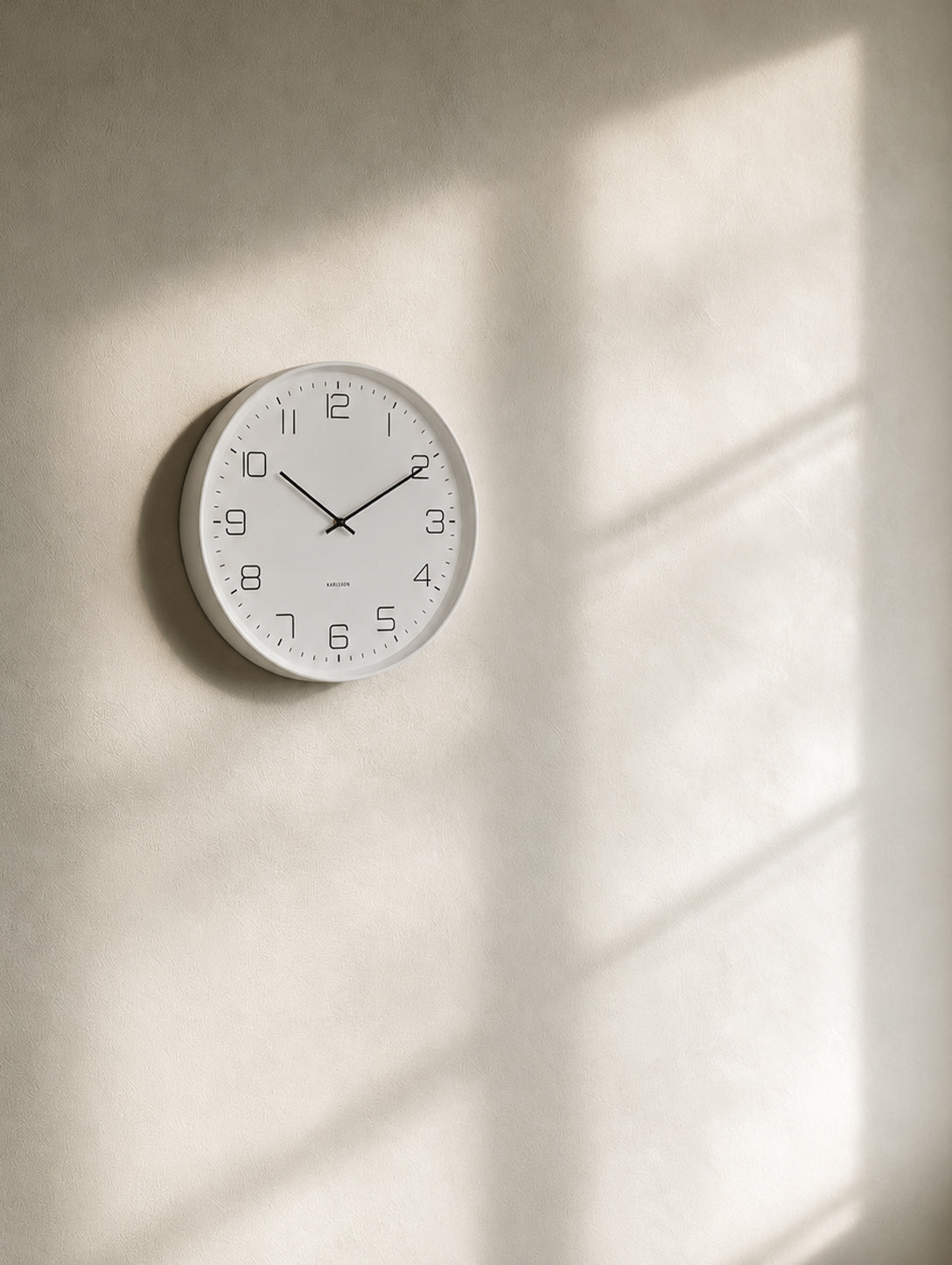
Living rooms. This is where a clock can be a feature. Warm materials such as wood grain soften a room of pale walls and linen. The Karlsson Pure Wood Grain Wall Clock comes in 22cm and 40cm, and the larger size works well as a focal point. For a calmer, more minimal look, the 40cm Karlsson Lofty in matte white almost disappears into a white wall, leaving just the numerals.
Kitchens. Clear, easy-to-read numerals matter most. The Karlsson New Classic comes in three sizes with a bold, legible dial.

Bedrooms and studies. Look for a silent sweep movement, where the second hand glides instead of ticking. It is the one detail that makes the difference between a clock you love and one that keeps you awake. Several of the Karlsson clocks we stock, including the Lofty and the New Classic, use a silent sweep. For a bedside, a small alarm clock such as the Karlsson Button Alarm Clock keeps the phone out of the bedroom.

Hallways and entries. A hallway is somewhere you pass through, so it can take a little personality. The Karlsson Modern Cuckoo Clock reworks the traditional cuckoo as a simple house shape with birdsong on the hour. It is a clock that tends to start a conversation.

Numbers, markers or neither
Full numerals are the easiest to read and feel the most traditional. Minimal markers, or no markers at all, look more sculptural but take a moment longer to read. As a rule, the more a clock is meant to be read at a glance, the more numbers it should have. The Karlsson Vintage Wall Clock, with raised numerals on a 35cm dial, is a good middle ground: classic, clear and quietly decorative.

A few practical notes
Use a proper wall hook or screw suited to your wall, not a nail tapped into plasterboard. Check where the clock's hanging point sits on the back before you mark the wall, because it is not always in line with the centre of the dial. And keep a spare battery in the drawer, because the clock always stops on the busiest morning of the week.
Browse our full range of wall clocks and table and alarm clocks.
In Short
To choose a wall clock, start with the wall: above furniture, a clock should be a third to a half of the furniture's width, and on an open wall 40cm or more holds its own, while 25 to 35cm suits kitchens, hallways and desks. Hang the centre of the dial at around 150 to 160cm from the floor, or 20 to 30cm above furniture. Choose clear numerals for kitchens, a silent sweep movement for bedrooms and studies, and something with personality, like a modern cuckoo clock, for hallways. Flux Boutique in Mount Maunganui stocks a wide range of Karlsson wall and alarm clocks.
Related: The Stendig Calendar: Why a 1966 Design Still Belongs on Your 2027 Wall and 20 Simple Ways to Transform Your Home (Without a Renovation)




Leave a comment
This site is protected by hCaptcha and the hCaptcha Privacy Policy and Terms of Service apply.