

How to Make Artificial Flowers & Plants Look Real: The Complete Unpacking & Shaping Guide
There is one thing we wish everyone knew before buying artificial flowers online:
Don't judge them straight out of the box.
When faux flowers and plants travel, they need to be packed tightly enough to protect delicate petals, leaves and branches. That means a beautiful eucalyptus spray can arrive looking almost completely flat. A trailing plant may emerge as one dense bundle. Flower petals can be folded against one another, and the branches of a larger plant may be tucked upwards around its trunk.
It is normal.
More importantly, it is usually completely fixable.
Many high-quality artificial botanicals are made with wired stems, flexible branches and individually adjustable foliage specifically so they can be reshaped after unpacking.
And that final shaping step makes an enormous difference.
The aim isn't to arrange every leaf and flower perfectly.
Quite the opposite.
Real flowers lean. Branches grow towards the light. Leaves overlap. Tulips droop. Some petals turn away from you. A vine disappears behind another leaf and reappears further down.
That slight imperfection is one of the biggest secrets to making artificial flowers look real.
So before putting your new artificial flowers and plants into their final position, give them a few minutes of attention.
Still deciding whether faux is right for you? Start with Everlasting Beauty: The Benefits of Choosing Artificial Flowers.
Here's exactly what we do.
First: Give Everything an Unboxing Reset

Before you reach for a vase, spend five to ten minutes undoing the shape created by its packaging.
1. Remove all the packaging first
Take off sleeves, ties and protective wrapping completely.
Trying to fluff a stem while part of it is still restrained makes it difficult to see its natural construction.
2. Find the individual branches
Look at where smaller branches, leaves, blooms or tendrils come away from the central stem.
These are generally the areas you'll be manipulating.
3. Work from the centre out
For a large plant, start with the trunk.
For a flower stem, start with the main stem.
Then work progressively outwards:
main stem, then branch, then smaller branch, then leaf or flower
It's much easier than randomly fluffing the outside.
4. Rotate as you work
A common mistake is creating something that looks lush from the front but completely flat from the side.
Turn the stem or plant as you go.
Artificial foliage needs depth as well as width.
5. Forget symmetry
You are not trying to make every branch equally visible.
Bring one forward.
Push another backwards.
Turn a leaf sideways.
Let another disappear behind the flower next to it.
Nature rarely grows in a perfectly arranged fan, and your faux botanicals shouldn't either.
How to Shape Different Types of Artificial Flora

This is where the biggest transformation happens.
Different botanicals need slightly different techniques, so rather than treating every faux flower the same way, work with the way that particular plant would naturally grow.
Real-Touch Flowers: Separate & Soften the Petals

Real-touch flowers such as orchids, roses and tulips can be incredibly convincing, but flattened petals are particularly noticeable because flowers naturally draw the eye.
Start gently.
Cup the flower head in your hand and separate any petals that have been pressed together.
Then use your fingers to:
- Ease the outer petals slightly outwards
- Lift petals that have become folded underneath others
- Turn some petals slightly forwards
- Allow others to fall backwards
- Open the flower gradually rather than flattening everything
Don't try to make the bloom perfectly round.
Real flowers rarely are.
What about creased petals?
Often, simply reshaping the bloom and leaving it unpacked for a while is enough for minor creases to relax.
You can also try cool moving air from a hairdryer at a distance to help separate compressed petals and fine foliage.
We recommend being cautious with heat. Artificial botanicals can contain different combinations of fabric, plastic, coatings, glue and paint, so a technique that works for one flower may damage another.
Start with your fingers and cool air rather than reaching immediately for high heat, steam or hot water.
The Tulip Trick: Let Them Droop

Tulips deserve their own rule.
Don't make them stand to attention.
Real tulips continue to move after they're cut. Their stems bend and their flower heads gradually lean and turn.
Use this to your advantage with faux tulips.
Give every stem a slightly different soft curve.
Allow:
- One flower to stand relatively upright
- Another to lean outwards
- One head to sit lower
- Another to curve gently across the arrangement
That uneven movement is what makes a faux tulip bouquet feel much more natural.
Wired Stems: Bend Them

One of the easiest ways to spot an artificial arrangement is a collection of perfectly straight stems.
If a faux flower contains a flexible wired stem, use it.
Rather than creating a sharp bend at one point, hold the stem with both hands and introduce one long, gradual curve.
Think:
)
rather than:
>
Then change the direction from flower to flower.
One bloom can lean left.
One can move forwards.
A taller flower might arch gently backwards.
A shorter one can fall towards the edge of the vase.
You don't need dramatic bends.
Tiny variations are often enough to make the arrangement feel much more natural.
Branches: One Long Curve, Then Splay

Tall branch stems such as willow and eucalyptus need to be opened in two stages.
Step one: shape the main stem
Give the central stem a long, gentle arc rather than leaving it rigidly vertical.
With a sculptural stem such as a Curly Willow Branch, you are looking for the irregular movement of a branch that has actually grown rather than something that has simply been unfolded.
Step two: splay the smaller branches
Starting near the bottom, gently pull the side branches away from the main stem.
Don't give every branch the same angle.
Bring one towards you.
Turn one sideways.
Push another backwards.
Let one sit slightly higher.
Lower another.
Keep rotating the branch while you work.
Flux hack
For very tall stems, put them into their final vase before making your last adjustments.
The height and width of the vessel affect how the branch falls, so you'll get a much better result shaping it where it will actually live.
Eucalyptus & Leafy Sprays: Spin, Fan & Fold

Eucalyptus and other leafy sprays often emerge from a parcel looking like a pressed flower.
The fix is simple:
think in 360 degrees.
Hold the stem vertically and slowly rotate it.
As you turn, fan the smaller branches out in different directions.
Some should come forward.
Some should go backwards.
Some can sit almost sideways.
Then move onto the individual leaves.
The Fold-Back Leaf Trick

This is probably one of the most overlooked tricks.
Packaging often leaves artificial leaves sitting almost parallel to their stem.
But real leaves generally grow away from it.
Gently fold or angle each flexible leaf outwards.
Think in layers:
Top leaves: slightly more upright
Middle leaves: spreading outwards
Lower leaves: softer, wider and sometimes slightly downward
Now rotate some of them.
Not every leaf needs to face you.
In fact, if you've carefully positioned every leaf so you can see its full face, the result can start to look artificial again.
Some should be edge-on.
Some should overlap.
Some should almost disappear.
Trailing Plants: Pull Apart First, Then Curve

Trailing artificial plants are perhaps the easiest faux plants to transform and the easiest to leave looking obviously artificial.
They often arrive with all their tendrils pressed together.
Don't simply hang the bundle over the edge of a pot.
Separate every trail first.
Take one forward.
Push one backwards.
Let another run sideways across the rim.
Allow a few to cross.
Let some disappear behind the planter.
You'll immediately create far more volume.
Then shape the individual tendrils.
Try the Thumb-Curve Trick

If the trailing stems are wired and flexible, rather than creating lots of small bends, use your thumb to help create one smooth arc.
Support the tendril near its base.
Place your thumb against the back of the flexible stem and gently draw the stem across it, gradually introducing a curve as you go.
It's a little like curling ribbon, only considerably gentler.
The result should be a soft continuous line, not a sequence of kinks.
And don't make them all identical.
Leave one trail relatively straight.
Curl another more dramatically.
Bring one forwards.
Let one hang long.
The irregularity is what makes pieces such as philodendron, hanging eucalyptus, String of Hearts and other faux plants look far more convincing.
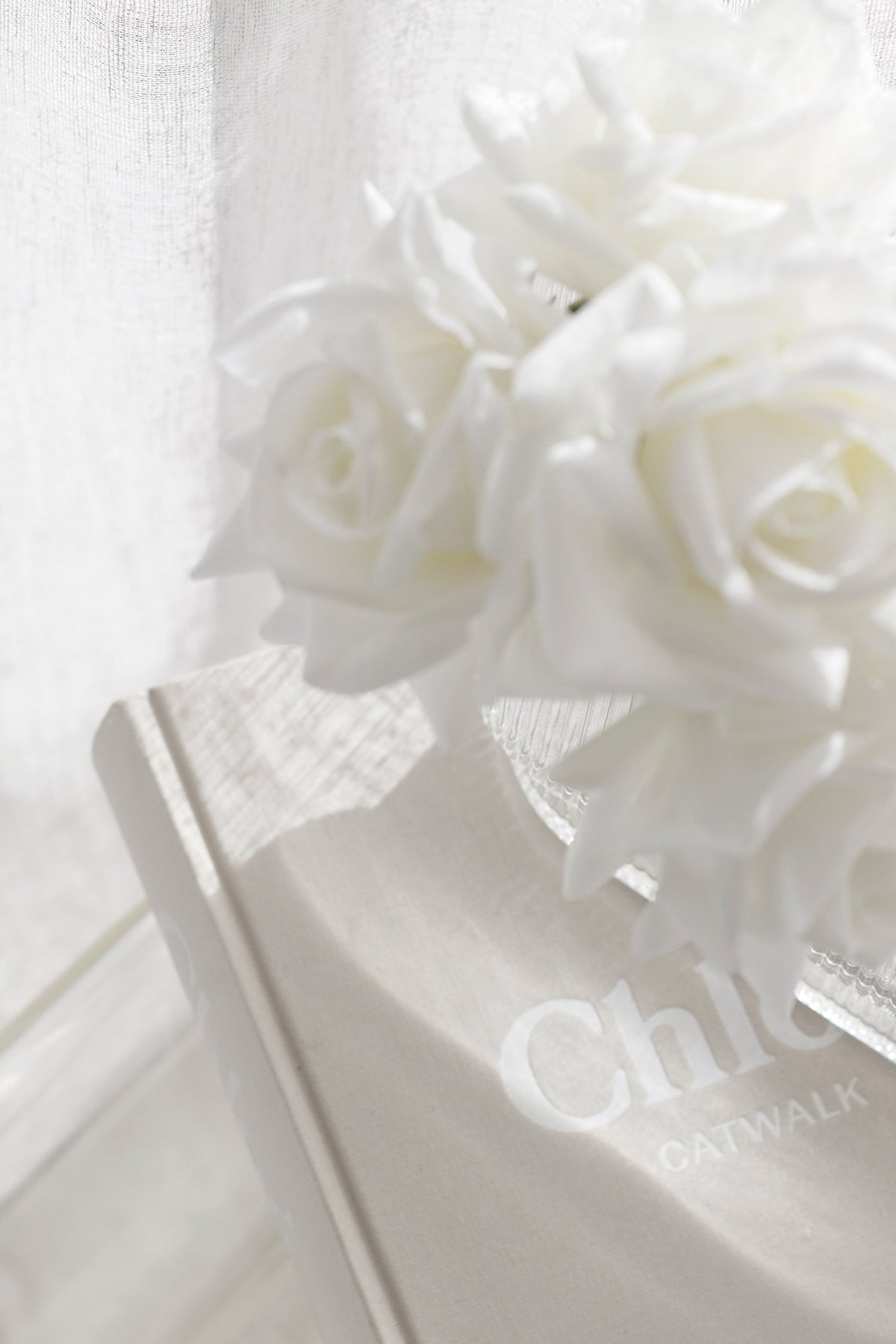
Hydrangeas & Full Blooms: Break Up the Ball

Large clustered blooms such as hydrangeas can sometimes arrive looking too round and too tidy.
Work from the outside towards the centre.
Gently:
- Separate compressed sections
- Bring some petals and clusters forwards
- Push others slightly backwards
- Rotate individual sections
- Create a subtly uneven outline
The goal isn't to make the flower bigger.
It's to make the surface less uniform.
Then give the stem a slight lean.
Hydrangeas have visually heavy flower heads, so allowing one to tip naturally over the side of a vase can look particularly convincing.
Pampas, Toi Toi & Dried-Look Grasses: Fluff Rather Than Bend

Dried-look stems need a different approach.
With a pampas-style or Toi Toi stem, the priority is usually volume.
Hold the stem upside down and give it a gentle shake.
Use your fingers to loosen compressed fibres.
For suitable fine faux grasses, cool moving air can also help separate the strands.
Avoid continually bending and manipulating the plume itself.
If the supporting stem is flexible, create your movement lower down instead so the grass head sits on a soft natural lean.
Large Faux Plants & Trees: Start at the Bottom
Large potted artificial plants often arrive with their branches folded upwards around the trunk.
Imagine opening an umbrella.
Start with the lowest branches and gently lower them away from the centre.
Rotate the plant as you work.
Then move to the next level.
Continue upwards until the overall silhouette feels balanced.
Only then start adjusting individual leaves.
Turn some leaves towards an imaginary light source.
Bring others towards you.
Let some sit edge-on.
Allow a few lower leaves to droop slightly.
Avoid arranging every branch at exactly the same interval around the trunk.
Then Walk Away From It

This is especially important with large plants.
Once you've shaped your faux Fiddle Leaf Fig or statement plant, put it in its final planter and move it into its intended position.
Then walk across the room.
Look again.
Large plants are part of the architecture of a room. They are rarely viewed from twenty centimetres away.
You may suddenly notice one side needs more width, a branch needs pulling forward or the top looks slightly too symmetrical.
Make those last adjustments from where you'll actually see the plant.
Make the Pot Look Real Too

Sometimes the giveaway isn't the plant.
It's the base.
If a faux plant comes in a utilitarian nursery pot, place the whole thing inside a larger decorative planter.
Then disguise any visible plastic or artificial-looking surface around the trunk.
Depending on the plant, you could use:
- Preserved or artificial moss
- Bark
- Coconut fibre
- Decorative stones or pebbles
That final layer can make the plant feel far more established.
Browse our plants and planters for vessels with enough scale to balance larger artificial greenery.
Now Style the Arrangement

Once the individual pieces are properly shaped, arranging them becomes much easier.
There are a few tricks worth remembering.
Create Depth, Not Just Width
People naturally spread flowers out sideways.
Don't forget the front and back.
Bring one bloom forward.
Push another deeper into the arrangement.
Let foliage disappear behind a flower.
Allow a taller stem to sit towards the rear.
You want the eye to move through the arrangement rather than simply across a flat wall of flowers.
Vary the Heights

If every bloom finishes at the same height, the arrangement can quickly feel manufactured.
Instead, create layers.
A simple formula is:
tall + full + loose
For example:
- A tall branch or foliage stem for height
- Hydrangea, dahlia or peony for volume
- Eucalyptus, Queen Anne's Lace or another airy stem for movement
You can keep the colour palette extremely restrained and still create an interesting arrangement simply by varying form.
Browse our current faux flower stems for pieces to mix together.
Leave Some Gaps

One of the old rules worth keeping is this:
don't overcrowd them.
Real flowers have negative space.
You can see daylight through branches.
Foliage doesn't fill every gap.
A beautiful stem has room to show its shape.
Sometimes removing one or two flowers improves an arrangement more than adding another three.
And sometimes a single beautifully shaped branch in a sculptural vase is all you need.
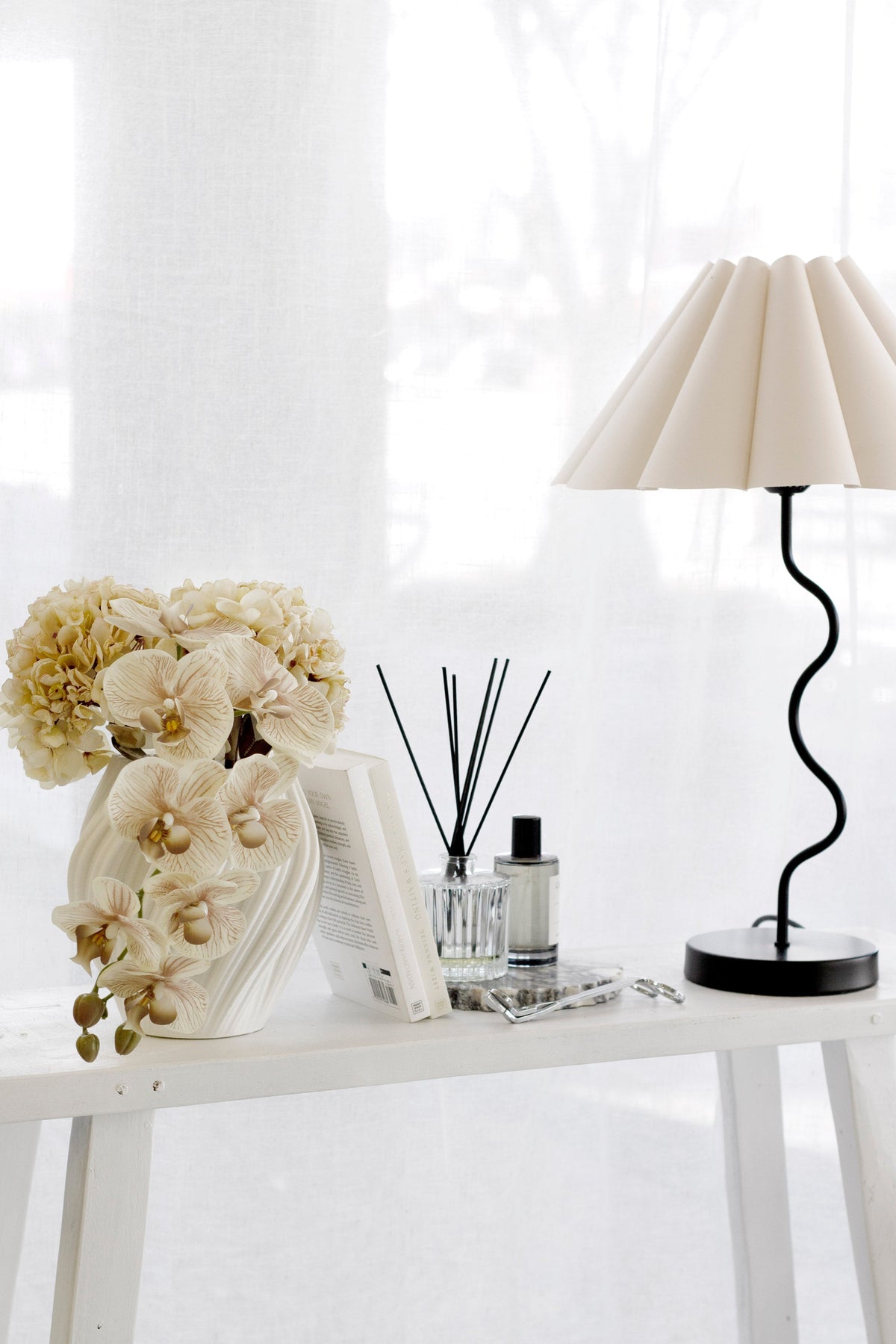
Use the Vase to Make Faux Flowers Look More Real

The right vessel can do half the styling for you.
A narrow-necked vase naturally holds one to three stems at deliberate angles.
A medium opening gives you enough room to create a loose arrangement while still providing support.
A wide-necked vase generally needs greater volume or substantial branching to stop everything falling around the perimeter.
Explore our vase collection when choosing the right proportion for your stems.
Try the Crossed-Stem Trick

If your faux stems keep collapsing against the sides of the vase, cross them over one another inside it.
The stems create a loose internal framework.
You can then rest other stems against that framework and position flowers much more naturally.
It's particularly helpful with wider vessels.
Don't Cut a Wired Stem Until You Need To

If you're styling flowers in an opaque vase, try bending the excess stem inside the vase before permanently shortening it.
You may be able to create exactly the height you want without cutting anything.
That means the same flower can later be used in a much taller vessel.
If you do eventually need to shorten a substantial wired stem, use suitable wire cutters rather than your good household scissors.
Using a Glass Vase? Try Acrylic Water

Clear glass can look beautiful with artificial flowers.
But it can also reveal one of their biggest giveaways:
perfectly dry faux stems sitting in an empty vase.
For a permanent arrangement, one of our favourite florist tricks is clear acrylic water, sometimes sold as faux water, illusion water or artificial water.
It's a transparent setting material designed to mimic the appearance of water inside a vase.
Once cured around properly arranged stems, it can create the illusion that your faux flowers are sitting in fresh water.
It works particularly well for:
- Tulips
- Orchids
- Cosmos
- Roses
- Simple single-variety arrangements
- Bud vases
- Clear cylinder vases
Make the stems look natural before pouring
This part matters.
Don't line the stems up neatly against the glass.
Cross them.
Let one angle towards the side.
Move another slightly behind it.
Vary their heights.
The acrylic water will preserve whatever arrangement you create, so get the stems looking convincing first.
Remember: this makes the arrangement permanent
Acrylic water is best for an arrangement you're happy to keep together.
Once the material has cured, removing or repositioning the stems can be difficult or impossible without damaging something.
If you're someone who loves swapping flowers between vases every season, use an opaque vessel instead and keep your stems flexible.
Always follow the acrylic-water manufacturer's instructions and check compatibility with both your chosen vase and artificial stems before use.
And don't substitute actual water just for appearance unless the manufacturer of your artificial stems specifically says it is suitable. Wired stems, adhesives and finishes are not necessarily designed to sit in water.
Style for Where the Flowers Will Actually Live

A dining-table arrangement and a console arrangement shouldn't necessarily be styled the same way.
Against a wall

If a vase sits on a console, shelf or bedside table against a wall, concentrate the volume towards the front and sides.
You don't need to waste your best flowers facing the plaster.
On a dining table

Rotate the vase constantly while you arrange it.
It needs to look beautiful from all directions.
Keep height in mind too, so people can see one another across the table.
On a shelf

Go simpler.
One sculptural stem, a small branch or a handful of loose flowers often looks more intentional than trying to fit a full bouquet into a small vignette.
In a large corner

Think about scale.
A beautifully realistic plant can still look wrong if it is too small for the room.
For a substantial empty corner, a larger tree usually looks more convincing and proportionate than a small tabletop plant elevated on a stand.
Learn From Real Flowers

One of the best styling tools costs nothing.
Look closely at the real thing.
Notice how a tulip curves.
Look at how eucalyptus leaves turn around a branch.
See which way an orchid faces.
Look at the space between flowers in a garden.
Notice how an old branch bends differently from new growth.
You don't need to copy nature perfectly.
You just need to notice how imperfect it is.
Keep Them Dust-Free

Nothing reveals artificial foliage faster than dust.
Regularly give faux flowers and plants a light clean using:
- A soft microfibre cloth
- A very soft clean brush for delicate flowers
- Cool moving air for intricate foliage
It's much easier to remove a light layer regularly than deal with months of built-up dust.
Avoid prolonged harsh direct sunlight where practical too, as repeated UV exposure can eventually fade many artificial materials.
And every time you clean them, take ten seconds to reshape anything that has moved.
For a full routine, see How to Clean Faux Flowers and Plants.
The Flux Five-Step Faux Flora Reset
If you only remember five things when a parcel of artificial flowers arrives, make them these:
1. Separate
Pull every branch, leaf, bloom and trailing stem away from the compressed position it travelled in.
2. Bend
Give wired stems gentle natural curves rather than leaving them poker straight.
3. Rotate
Turn leaves, branches and blooms in different directions to create three-dimensional depth.
4. Imperfect
Let something lean. Let a flower droop. Hide a leaf. Leave a gap.
5. Step Back
Make your final adjustments from where the arrangement will actually be seen.
Frequently Asked Questions
Why do artificial flowers look flat when they arrive?
Artificial flowers are often packed compactly to protect them during shipping. Flexible branches, wired stems and foliage may therefore arrive much flatter than their intended finished shape. Separating and reshaping them after unpacking restores their volume and movement.
Can you bend artificial flower stems?
Many high-quality artificial flowers contain flexible wire specifically so the stem can be shaped. Create gentle gradual curves rather than sharp kinks, and never force a part of the stem that feels rigid.
How do you uncrease faux flower petals?
Begin by gently separating and reshaping the petals with your fingers. Allow the flower some time out of its packaging. Cool moving air from a distance can help some materials relax, but avoid strong heat unless the manufacturer confirms it is safe for that particular flower.
How do you make artificial plants look fuller?
Work from the centre out rather than simply pulling the outermost branches apart. Separate individual branches and position some forwards, sideways and backwards. Rotating the foliage into three dimensions creates far more apparent volume.
How do you make artificial hanging plants look real?
Separate every individual tendril before styling the plant. Vary the length, direction and curve of the trails, bring some around the sides of the pot and allow others to overlap or disappear behind the planter.
Can you put faux flowers in a glass vase?
Absolutely. For a loose, changeable arrangement, style the visible stems carefully so they cross naturally inside the glass. For a permanent arrangement, clear acrylic water can be used to create the illusion of fresh water around the stems.
Can you use real water with artificial flowers?
We wouldn't use real water purely for appearance unless the manufacturer specifically confirms the artificial stem is suitable for it. Internal wire, adhesives, coatings and other materials may not be designed for prolonged water exposure.
Can you cut artificial flower stems?
Many wired stems can be shortened with suitable wire cutters. Before cutting, try bending the excess stem inside an opaque vase so you retain the option of using the flower in a taller vessel later.
How often should artificial flowers be cleaned?
There isn't a strict schedule. Lightly dust them whenever you notice build-up. Regular gentle cleaning is easier on the flowers than allowing heavy dust to accumulate. For a full routine, see How to Clean Faux Flowers and Plants.
In Short
The secret to making artificial flowers look real isn't perfection.
It is undoing perfection.
Open the petals.
Fold back the leaves.
Curve the stem.
Pull the branches apart.
Turn one flower away.
Let another lean.
Leave some empty space.
Quality faux flowers are designed to be manipulated, and those few minutes between unpacking them and placing them in a vase are often what make the biggest difference.
Explore our complete Artificial Flora collection, including faux flowers and faux plants.
Because the best artificial flowers shouldn't look freshly unpacked.
They should look freshly gathered.
Related: How to Choose the Right Vase for Your Stems: Height, Neck and Proportion



Leave a comment
This site is protected by hCaptcha and the hCaptcha Privacy Policy and Terms of Service apply.