

The Art of Styling with Trays: Simple Layers, Beautiful Impact
Because beauty often begins with boundaries.
Ask most people what is on their coffee table right now and the honest answer is a remote, a half-read magazine, a glass from last night and a candle that has drifted to the edge. None of it is ugly on its own. It is the lack of an edge that makes it read as mess. A tray gives those same objects a frame, and the moment they sit inside one they stop being leftovers and start looking like a decision.
That is the whole trick, really. A tray does not add anything to a room so much as it draws a line around what is already there. Everything inside the line belongs together. Everything outside it can be cleared without thought. For a small object it carries a surprising amount of order, which is why it turns up in nearly every styled home you have ever admired.

Why a tray changes how a surface reads
Group four loose things on a bench and the eye counts four things. Put the same four on a tray and the eye counts one. That is the first job of a tray: it collapses clutter into a single shape, so a surface with plenty on it can still feel still. The second job is permission. Because the tray marks out where the styled part lives, the rest of the table is allowed to be empty, and empty space is what makes the styled part look considered rather than crowded.
Trays also repeat well. One travertine round on the console, a smaller sculptural stone dish by the bed, a ceramic catchall on the vanity, and the house starts to feel like it was styled by the same hand even when the rooms are quite different. Material does most of that work. In a coastal New Zealand home, stone, pale ceramic, glass and warm timber sit comfortably against linen and white walls, and they stay out of the way of whatever the season puts on the table.

The coffee table, where most trays earn their keep
The coffee table is where a tray is most useful, because it is the one surface in the house that everybody uses and nobody owns. Start with a tray that contrasts the tabletop so it reads as a shape: stone on timber, timber on glass, something pale on something dark. Lay a book or two inside it as the base layer, then build upward with one taller piece and one small one. A round travertine tray with a hardcover, a metal candle and a single bottle is close to the whole formula.

If the table is large, a marble tray with a wavy edge adds movement without adding colour. The point is not to fill it. Two or three objects with room between them will always read better than six pushed together, and the empty part of the tray is doing as much styling as the full part.

Leave clear table around the tray. If you find yourself nudging it to make room for the remote, the tray is too big for the table, not the other way round.
Beside the bed, keep it low and quiet
A bedside table has a narrow brief. It needs to hold a lamp, water, the book you are actually reading and whatever comes off at night, and it needs to look calm while doing it. A small round stainless steel tray is the easiest answer. Sit it on top of a stack of two books to lift it to lamp height, then let it catch the rings, the hand cream and the perfume so the tabletop itself stays clear.

Soft finishes suit this spot. A curved travertine tray against boucle and linen, a glossy ceramic dish on a timber top, a terrazzo square tray beside a vase of hydrangeas. The tray should feel like part of the bedding palette rather than an accessory placed on top of it.


The vanity and the bath, where function comes first
Bathroom benches collect bottles, and bottles in a row look like a shop shelf. A tray turns them into a set. Choose something that can live with water: a marble look silicone tray wipes clean and will not mind a wet soap, and a small ceramic wave dish keeps a bar of soap off the bench without any fuss at all.

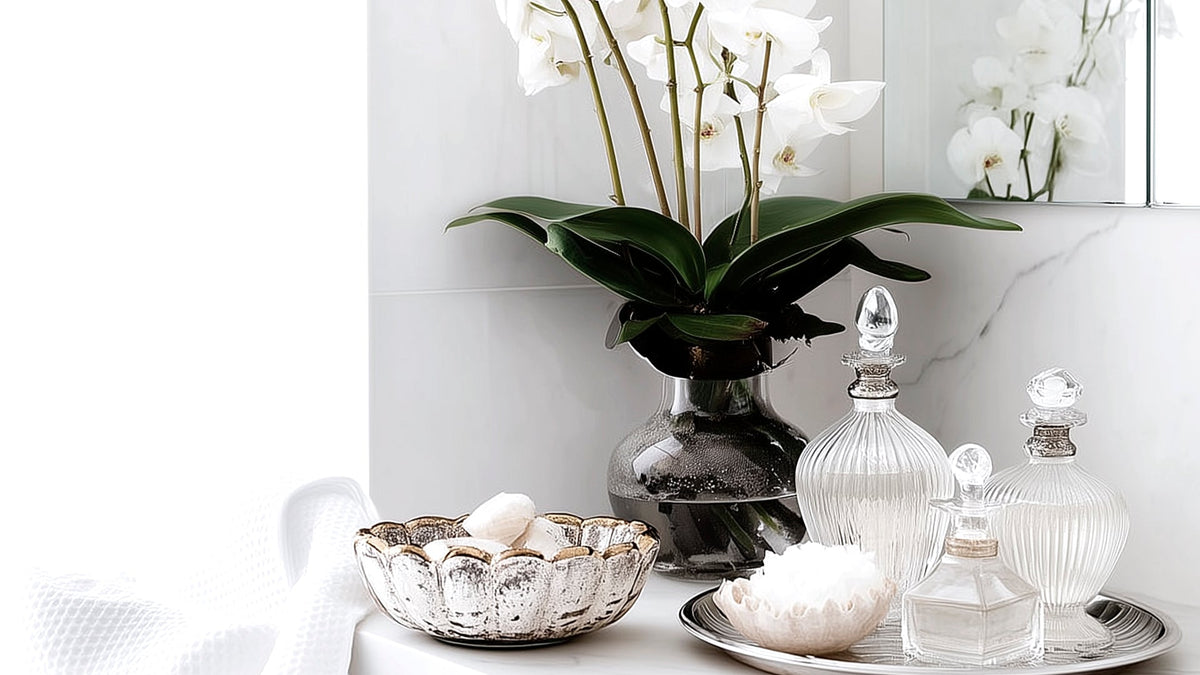
On a vanity, one hand wash, one hand cream and one small green thing in a glass vase is plenty. The petal edge of the Elle marble tray does the decorating; the products just need to sit neatly inside it.


The console and the entry, the welcome moment
The hallway table is the first surface you see coming home and the last one on the way out, so it is worth styling with a little care. A tray here is practical before it is pretty: keys, sunglasses and the post have somewhere to land, which means they stop landing everywhere else. A handmade terrazzo tray does this quietly on a timber top. Give it a tall companion, a vase of stems or a sculptural piece, and the console is done.

A footed stand works the same way with a little more presence. Raised off the books, the Nome travertine stand holding a single sculptural object turns a stack of reading into a small still life, and it is the easiest place in the house to swap in something seasonal. A scalloped travertine tray beside a sculptural vase does the same job with a softer edge.


The small dish, for the things that would otherwise go missing
Not every tray needs to hold a vignette. Some of the most useful ones hold one thing. A fluted ceramic dish no wider than your hand will take a perfume bottle, a pair of earrings or the ring you take off to wash up, and because it is small it can live on a book, a shelf or the corner of a desk without asking for space.

These little dishes are also where fragrance tends to end up, which is no accident. A roll-on perfume oil in a glass bottle is a lovely object in its own right, and a white rippled dish or a sculptural stone tray gives it a place to be seen rather than lost in a drawer.

The Noosa oval dish in a soft cashmere tone does the same job with a bud vase and a candle, and the mirrored silver cloud tray catches the light on a dressing table where everything else is matte.


Five habits that make any tray look styled
Work in odd numbers. Three objects, or five on a large tray, settle more naturally than two or four. If you only have two, make one of them a book so it reads as a base rather than a pair.
Vary the heights. Something tall, something middling, something low. A vase, a candle and a dish is the classic trio, and it works because the eye has somewhere to travel. On a small round like the Bay travertine tray, a chain and a bottle are enough.

Mix the textures, not the colours. Stone against glass, glossy ceramic against linen, timber against marble. Keep the palette to two or three neutrals and let the materials provide the contrast. The Glacier bubble glass tray on a linen bound book is that idea in one object.

Put one living thing on it. A stem, a sprig, an air plant in a glass. It does not need to be a bouquet. One green note stops a stone and ceramic arrangement from feeling like a display cabinet.
Leave a gap. The most common mistake is filling the tray edge to edge. Take one object away and look again. Nine times out of ten it looks better without it.

Scent belongs on a tray too
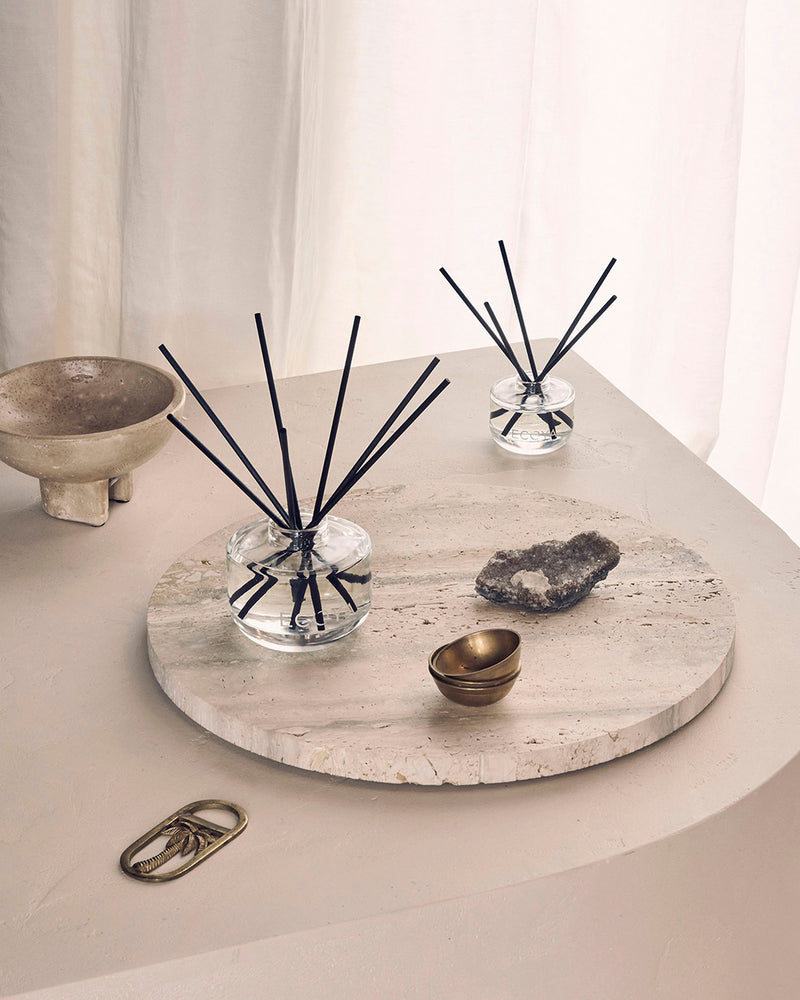
A reed diffuser standing alone on a bench looks like it was forgotten there. On a tray, beside a candle or a small bottle, it becomes part of the arrangement, and the tray does the practical work of catching any drips. The same goes for a candle: a stone base like the Moon travertine tray under it looks intentional and keeps wax off the furniture. If you are building a tray for the living room or the hallway, consider making fragrance one of your three objects. It is the one element of the vignette that works even when nobody is looking at it.

For more on building a home that feels quiet without feeling empty, read Soft Minimalism: How to Create a Home That's Calm, Warm, and Visually Rich.
The short of it
Styling with trays is a way of giving everyday objects a boundary. A tray groups loose items into one shape, lets the rest of the surface stay empty, and repeats across the home to tie rooms together. Use a contrasting material so it reads clearly, build with a book as the base, vary heights, keep to two or three neutrals, add one living stem and always leave a gap. On the coffee table it corrals the things everyone uses, by the bed it keeps the table clear, on the vanity it turns bottles into a set, and in the entry it catches keys before they scatter. Small dishes do the same work for single objects like perfume and rings. Stone, pale ceramic, glass and timber suit coastal New Zealand homes and stay neutral through every season.

Leave a comment
This site is protected by hCaptcha and the hCaptcha Privacy Policy and Terms of Service apply.