



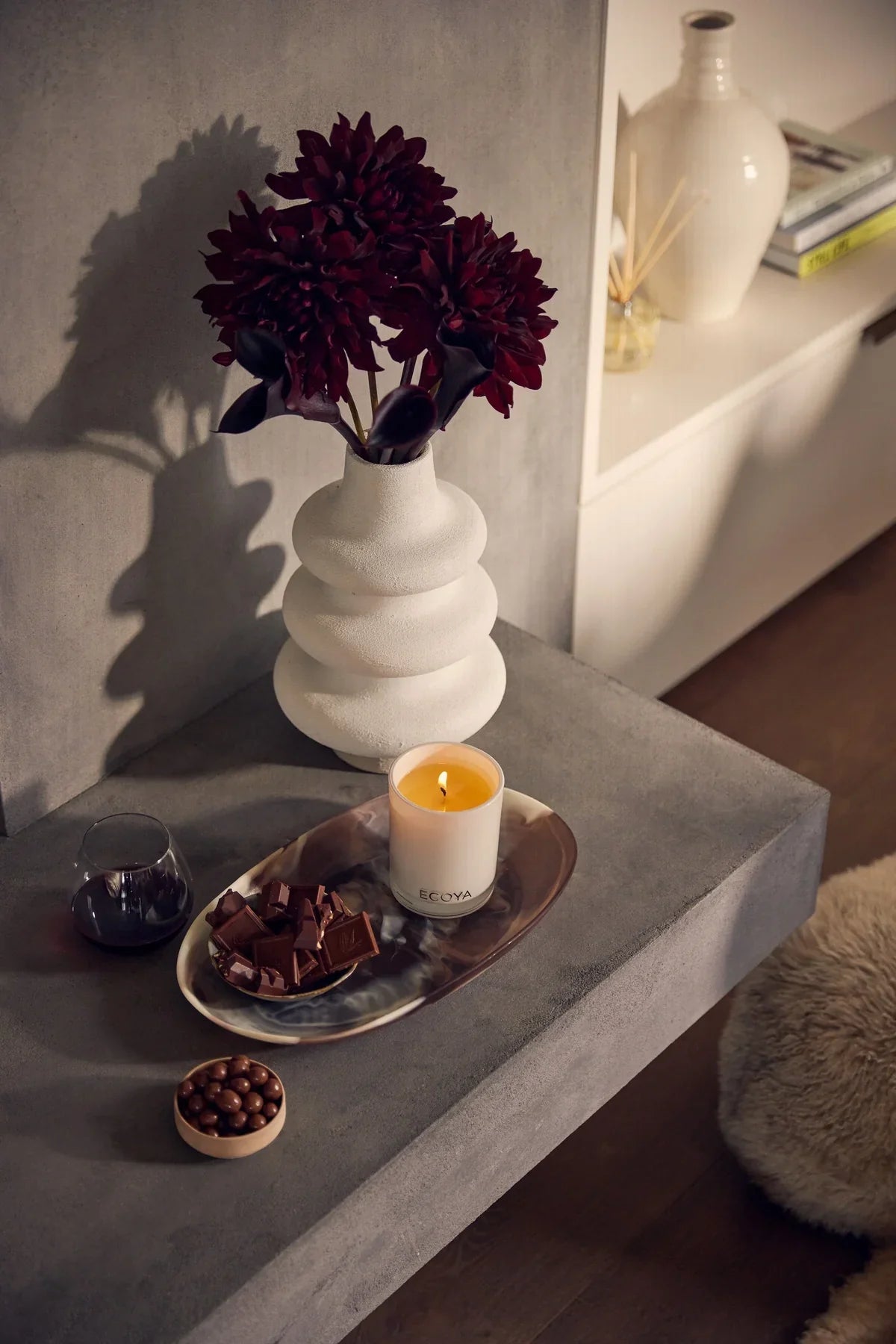
The Psychology of a Flame: Why Lighting a Candle Feels So Good
There is something ancient and immediate about lighting a candle. The quiet scratch of the match. The flare, then the flicker. The way the flame moves, alive but contained. We have done it for millennia, for prayer, for ceremony, for celebration, for remembrance.
But even on an ordinary weekday afternoon, with laundry waiting and a list undone, that one small act feels like more than it is. It feels like a pause. A moment of care. A line drawn under the first half of the day.
Here is why that happens, and how to make more of it.
1. It anchors you in the present

So much of worry lives elsewhere, in the future, the unknown, the undone. Lighting a candle brings you here.
- Strike the match
- Watch the flame catch
- Notice the first curl of scent
- Let your eyes settle on the flicker
It gives your attention something to do, but not too much. Just enough to occupy the senses while the thinking slows down. It is the same principle behind grounding techniques, which work by pulling attention out of a spiral and into something immediate and physical. A candle is simply a more pleasant version of it, and it sits neatly alongside the other ways a home can be arranged around ease rather than stimulation.
2. It repeats, and repetition is reassuring

Lighting a candle is the same every time, and the sameness is the point. When a week is unpredictable, the things that stay identical carry more weight than they should. A candle lit before dinner each evening, or before you sit down to write, becomes a marker. Not because it changes anything, but because you have done it before and you know what comes next.
That is most of what a ritual is: a familiar sequence that tells you where you are in the day. Some stick and some never take, and the difference is usually how the ritual has been designed rather than how much you wanted it.
3. What the research on firelight actually says
There is a reason we gather around fires and stare into them, and it does get studied. The paper most often cited is a 2014 study by the anthropologist Christopher Dana Lynn, published in Evolutionary Psychology, which measured the blood pressure of 226 adults before and after watching simulated fires.
Blood pressure did fall, but only in one condition: fire with its sound. Participants who watched a silent flickering fire showed no significant change, which the study read as evidence that the effect is not visual alone.
That is worth sitting with, because a candle is silent. Whatever a candle does for you, this research does not show that watching a flame lowers your blood pressure. What it does suggest is that fire holds attention in a way that involves more than the eyes, and that the association with warmth, food and company runs deep in us. Our candles will not change your heart rate. They are very good at making a room feel like someone lives in it.
4. It marks the shift from doing to being

A candle works well as a switch, a way of moving from one state into another.
- From work mode to rest mode
- From outward focus to inward attention
- From noise to quiet
- From day to evening
Tie it to a specific moment, whether that is journalling, dinner, a bath or the last hour before bed, and it becomes a cue you stop having to think about. A threshold. A very small ceremony. It is the same instinct behind building a home around rhythm and rest rather than constant motion.
5. It is a small act of choice

When a great deal feels out of your hands, lighting a candle is a reminder that you can still shape the room you are standing in. You choose the scent. The vessel. Where it sits and when it goes on. You can do it for no reason other than wanting to, which is rarer than it sounds.
That is agency in a very small frame, and it is the reason we keep our home fragrance range broad enough that the choosing is part of the pleasure. It is also a much older idea than it looks, one we have written about as a design philosophy for uncertain times.
So light the candle
Even when it feels silly. Even when the kitchen is a mess. Even when you are not sure it makes any difference.
Because it does, not in a sweeping way, but in the small steady way of becoming someone who pauses. Who notices. Who lets a home be a place to land at the end of the day.
In Short
Lighting a candle is not treatment and it is not a fix. It is a repeatable, sensory, chosen act that marks a point in the day, and those are worth more than they look. The research on firelight is thinner than the internet would have you believe. The pull it has on us is not.




Leave a comment
This site is protected by hCaptcha and the hCaptcha Privacy Policy and Terms of Service apply.