


How to Layer Cushions and Throws: Sizes, Combinations and Seasonal Swaps
If you have ever bought a cushion you loved, brought it home, and found it looked wrong on the sofa, you are in good company. Cushions are almost never the problem on their own. It is how they sit with everything else: the size of the others around them, the texture of the sofa, the throw folded over the arm.
Get the layering right and a plain sofa or bed looks finished. Here is how we approach it.
Sizes that work together
The simplest way to make a group of cushions look considered is to vary the size, from largest at the back to smallest at the front.
On a sofa. A 50 x 50cm cushion is the workhorse size for most sofas. On a deep sofa, you can go up to 55 or 60cm at the back. In front, add something smaller or a different shape, such as a round, a lumbar or a sculptural piece, to break up the squares.
On a bed. Start with your sleeping pillows, then add a pair of 60 x 60cm euro pillows standing behind them. One or two smaller cushions in front are enough. The Ivory Frill Euro Pillowcase from Bengali Collections gives the back row a soft, ruffled edge that stops a bed from looking too formal.

How many is enough?
There is no fixed number, but there is a point where cushions start to get in the way. If you have to move them every time you sit down, there are too many. On a three-seater sofa, three to five usually looks generous without being fussy. On a bed, the pillows you sleep on plus two to three decorative pieces is plenty.
Symmetry, with matching pairs at each end, feels calm and a little formal. An odd number arranged loosely, with a cushion or two at one end and a throw at the other, feels more relaxed. Neither is right. Choose the one that suits how you use the room.
Mix textures, keep the palette tight
The combinations that look collected rather than bought as a set tend to share a colour story but vary in texture. Two or three colours, drawn from the room, and a mix of smooth, nubbly and soft surfaces.
In a coastal-neutral room, that might be linen or cotton beside something woven, with one sculptural shape to catch the eye. The Small Shell Cushion in Mist does this beautifully: soft grey, scalloped and playful without adding a new colour.

A fringed or woven cushion, like the Cream Woven Cushion, adds texture in the same tonal family. For a little softness and sheen, the sculptural Velvet Knot Cushion sits well in front of flatter squares. And if you want a single pattern, keep it gentle and hand-drawn, such as the Khaki Palm Cushion Cover.

Throws: draped, not folded into a square
A throw that looks as though someone has just got up from under it makes a room feel lived in. One folded into a precise square on the sofa arm looks like a showroom.
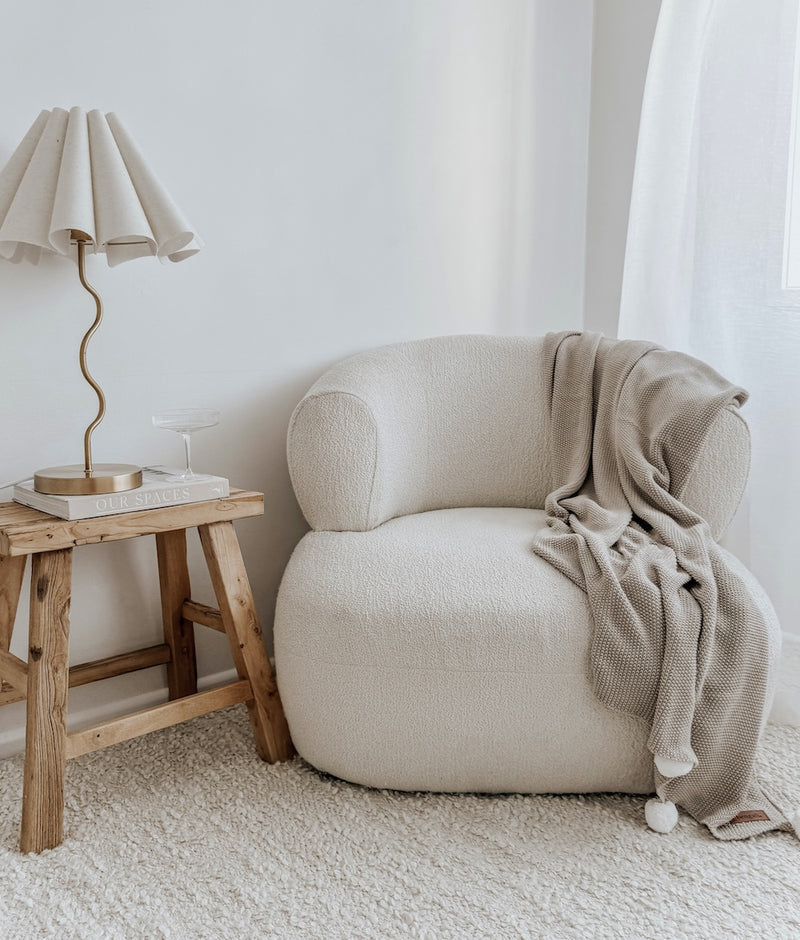
On a sofa or armchair, drape the throw over one arm or across a corner so it falls unevenly. On a bed, fold it into thirds lengthways and lay it across the bottom third of the bed, then pull one corner slightly off-centre. The Greige Pom-Pom Lounge Throw is a good example of a throw that looks best left loose, the pom-pom edge falling over the arm of a chair.
A quilt can double as a throw on a bed, especially in summer. The Reversible Khaki Gingham Cotton Quilt turns back to a plain khaki side, so you can show a little of each.

Swapping layers with the seasons
Cushion covers and throws are the easiest way to shift a room between seasons without changing anything else. As we head into a New Zealand summer, lighter layers make sense: cotton, linen and gingham, in paler shades, with fewer cushions overall. When the evenings cool down in autumn, bring back the heavier textures, such as velvet, bouclé and chunky knits, and add a second throw.
Keeping a set of covers for each season, and swapping the inners across, saves space in the cupboard and makes the change a ten-minute job. We wrote more about layering for comfort in Layering for Calm.
Browse our cushions, throws and bed linen. Some pieces are available in small quantities, so if you see a combination you like, it is worth choosing the set together.
In Short
To layer cushions and throws, vary the size from largest at the back to smallest at the front: 50 x 50cm is the standard sofa cushion, and 60 x 60cm euro pillows form the back row on a bed. Three to five cushions suit a three-seater sofa, and two or three decorative pieces are plenty on a bed. Keep to two or three colours and mix textures such as linen, woven cotton, velvet and sculptural shapes. Drape throws loosely rather than folding them, and swap to lighter cotton and linen for summer and heavier velvet and knits for winter.



Leave a comment
This site is protected by hCaptcha and the hCaptcha Privacy Policy and Terms of Service apply.