

Why We’re So Drawn to Light (and How to Design With It)
For as long as humans have been telling stories, we’ve been obsessed with light.
The way sun hits the ocean and turns it to liquid metal. The shimmer of glass on a windowsill. The dappled pattern of sunlight through trees that makes a plain wall suddenly feel alive. These aren’t just pretty effects; they touch something deep in us.
Modern architects have been just as fixated. Le Corbusier famously described architecture as “the masterly, correct and magnificent play of masses brought together in light,” reminding us that form is only truly revealed when light and shadow touch it.
Louis Kahn went further, sensing light as “the giver of all presences,” with shadow belonging back to light rather than opposing it.
This post explores why we’re so mesmerised by light in all its forms (refraction, reflection, shimmer, dappled light) and how to design homes that honour that fascination. We’ll weave together psychology, philosophy, and architectural thinking, with small, practical ways to bring more beautiful light moments into your own spaces using pieces from our décor, glassware, mirrors, faux florals and candles.
Why Light Feels So Good: A Psychological (and Phenomenological) Lens 
Refraction on glass, ripples of light on water, shadows through leaves. These all have something in common:
-
They’re complex but not chaotic
-
They shift gently over time
-
They sit between “too plain” and “too overwhelming”
Our brains love this kind of soft complexity. Flat, even light can feel dull; harsh, flickering light can be stressful. But patterned light (glints, shadows, tiny movements) gives the visual system a low-effort puzzle to enjoy. You don’t have to think about it. You just look, and something in you quietly says, yes, this.
Phenomenological writers like Juhani Pallasmaa have argued that it’s precisely the subtlety of light and shadow that awakens us. He notes that it’s often the nuances of shadows and the dimly lit which actually tickle the senses, rather than uniform brightness.
In other words, our bodies come alive when light is allowed to be a little mysterious.
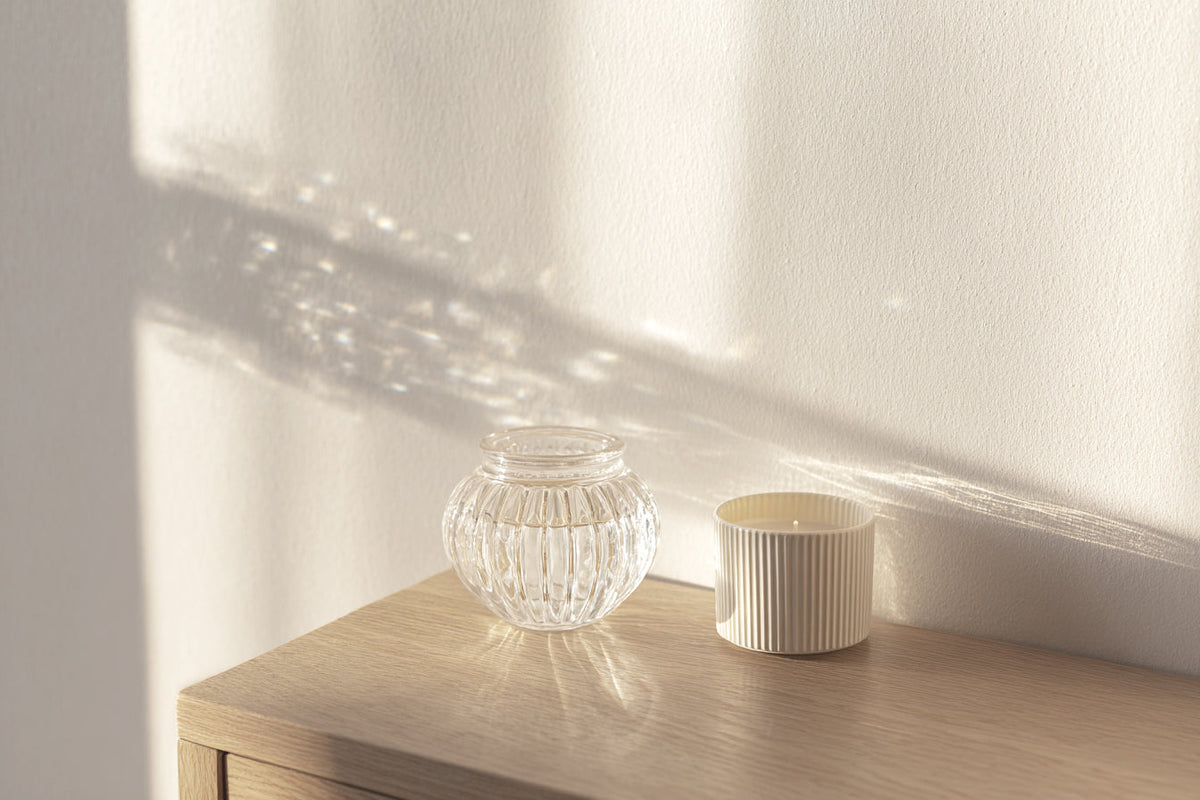
Something as simple as morning sun catching a cut-glass vase from our glassware collection, scattering tiny shards of light across the wall, can be enough to stop you in your tracks. It’s not just decoration; it’s gentle stimulation for a curious, sensitive mind.
If you’ve always been drawn to light, it can mean:
-
You notice small shifts in light and texture
-
You notice nuance that others miss
-
Your brain uses light as a way to both engage and soothe at the same time
 For many of us, pausing to watch light move across a room, or candlelight flicker in a ribbed glass candle holder, becomes a tiny daily ritual, an easy way back into the present moment.
Light as Meaning: More Than Just Brightness
Light has always carried symbolic weight:
-
Insight and clarity: “seeing the light”
-
Hope: “a light at the end of the tunnel”
-
Warmth and connection: gathering around a fire, a lamp, a candle
Architectural theory circles back to this again and again. In The Eyes of the Skin, Pallasmaa warns that spaces which are evenly, brightly lit can actually paralyse the imagination, whereas ambiguous light and shadow support a richer sense of place and being.
Different forms of light carry different meanings:
Refraction (light bending through cut glass) hints at the idea that truth and experience are multifaceted, not one straight line. No wonder a simple carafe or vase that throws rainbows across the table feels so quietly magical
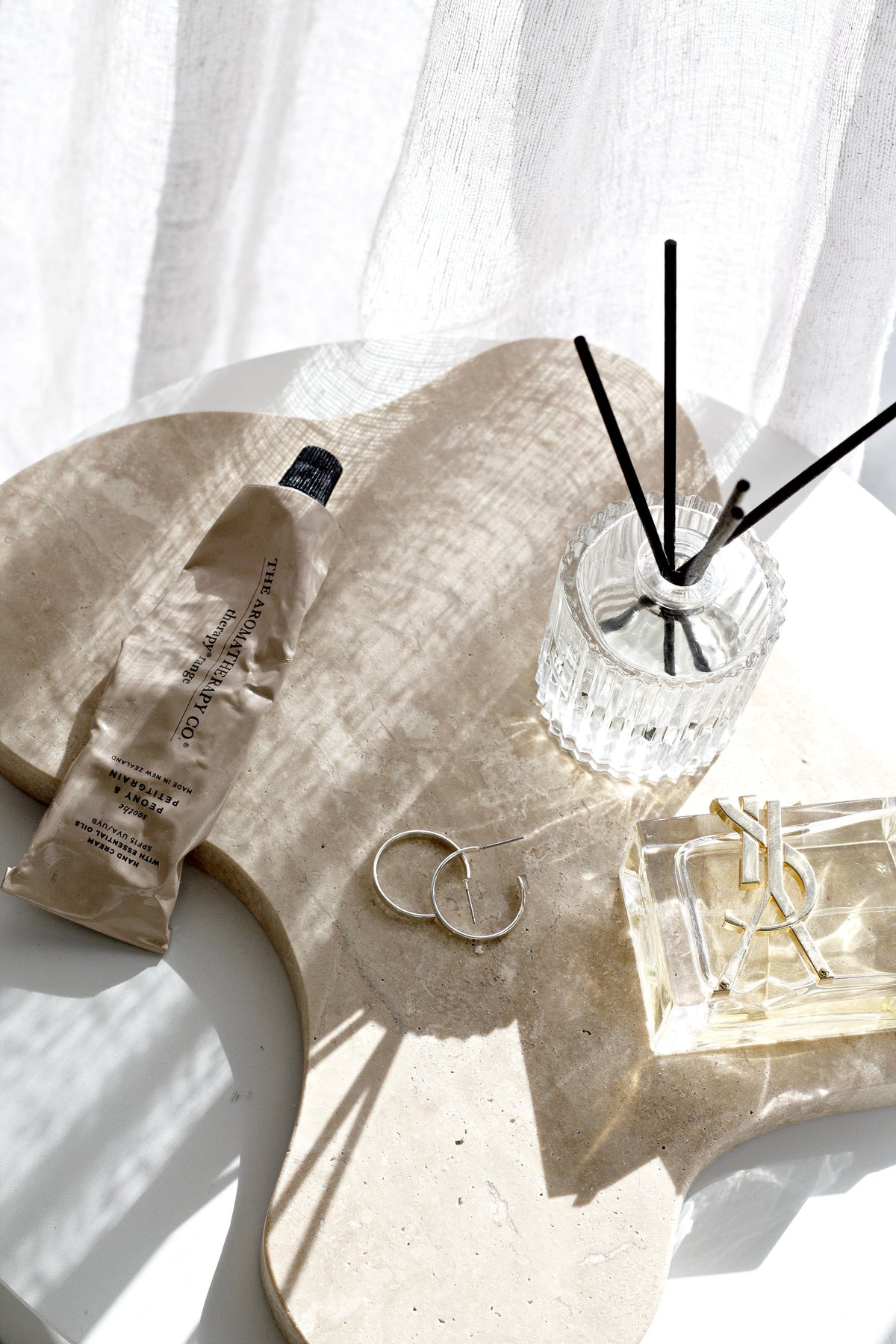
Reflection (mirrors, glass, polished trays) echoes self-awareness and relationship, seeing ourselves and our surroundings from another angle. A wall mirror from our mirrors collection, or a reflective tray styled with a candle and a bud vase, doesn’t just bounce light; it shifts how we see the room.
Dappled light (through trees, screens, sheers) lives in the in-between, not pure light, not pure shadow. It mirrors those liminal phases of life: change, becoming, not-quite-there-yet.
If you’re strongly drawn to these forms of light, there’s a good chance you’re also drawn to nuance, thresholds and in-between states in your inner life, more interested in layers than black-and-white answers. Your home can quietly reflect that back to you.
Designing With Light: Practical Ways to Honour the Fascination
When we take our love of light seriously, it becomes a design brief:
“Create spaces that let light move, soften, shimmer and glow.”
Instead of only asking “Is this room bright enough?”, we start asking:
-
How does light travel through this space over the day?
-
Where can it break, reflect or dapple?
-
How can light help people here feel calmer, more grounded, more alive?
Peter Zumthor, in Atmospheres, talks about planning a building almost as a mass of shadow first, then “hollowing out” the darkness with light so that light itself feels like a material entering the space.
You don’t need to be an architect to borrow that idea: think of your home as a series of gently shadowed volumes, and then choose where light should pour, skim, or shimmer.
Here are some simple ways to do that.
1. Let the Architecture Do the Heavy Lifting
If you’re working on a new build or renovation, start with orientation and volume:
-
Place living, kitchen and reading zones where they’ll catch morning or late-afternoon light, depending on how you live.
-
Use voids, stairwells and skylights as light wells so sunlight can move down walls and across floors throughout the day.
 Kahn described great buildings as places where light and shadow define space, where presence is created as much by what light doesn’t touch as what it does.
So, think not just “more windows”, but where do I want light to arrive, and where do I want it to withdraw?
Even in an existing home, you can notice: Where is the best light? Then locate key moments there: a reading chair, a dining table, a styled console.
A simple breakfast table vignette with a linen runner, a glass jug and a small vase from our tableware and décor collections will feel completely different when it’s bathed in early light. You’re not just arranging objects; you’re curating a light moment.
2. Invite Refraction, Reflection and Shimmer
Think less “more lights” and more “more to do with the light we already have.”
Refraction 
-
Use textured or ribbed glass in vases and candle holders.
-
Place cut glass pieces where they’ll catch sun: window ledges, sideboards, coffee tables.
Our textured and ribbed glass vases and candle holders are perfect for this: small, moveable and transformative when the light hits.
Reflection 
-
Hang mirrors where they’ll bounce natural light deeper into a room (without reflecting clutter).
-
Style polished or metallic trays, picture frames and brass candle sticks so they catch small highlights.
 Here, Le Corbusier’s line about architecture as a “play of masses… in light” becomes practical: your mirrors and reflective objects are part of that play, quietly collaborating with the sun.
Think of mirrors and reflective objects as co-designers, not afterthoughts.
Shimmer 
-
Layer glass or metallic trays near windows; add a candle, a small sculpture and a vase.
-
Choose textiles with a bit of tonal variation so side light creates movement across cushions and throws.
Our trays, sculptural vases and cushions are lovely for this: they create gentle “shimmer zones” as the sun shifts.
3. Create Dappled, Softened Light
 Dappled and filtered light is lovely to be around. It feels natural, safe and softly alive.
-
Outside, use trees, climbers or pergolas to cast patterned shadows on decks and through windows.
-
Inside, layer sheer curtains over blinds so harsh daylight becomes a soft wash.
-
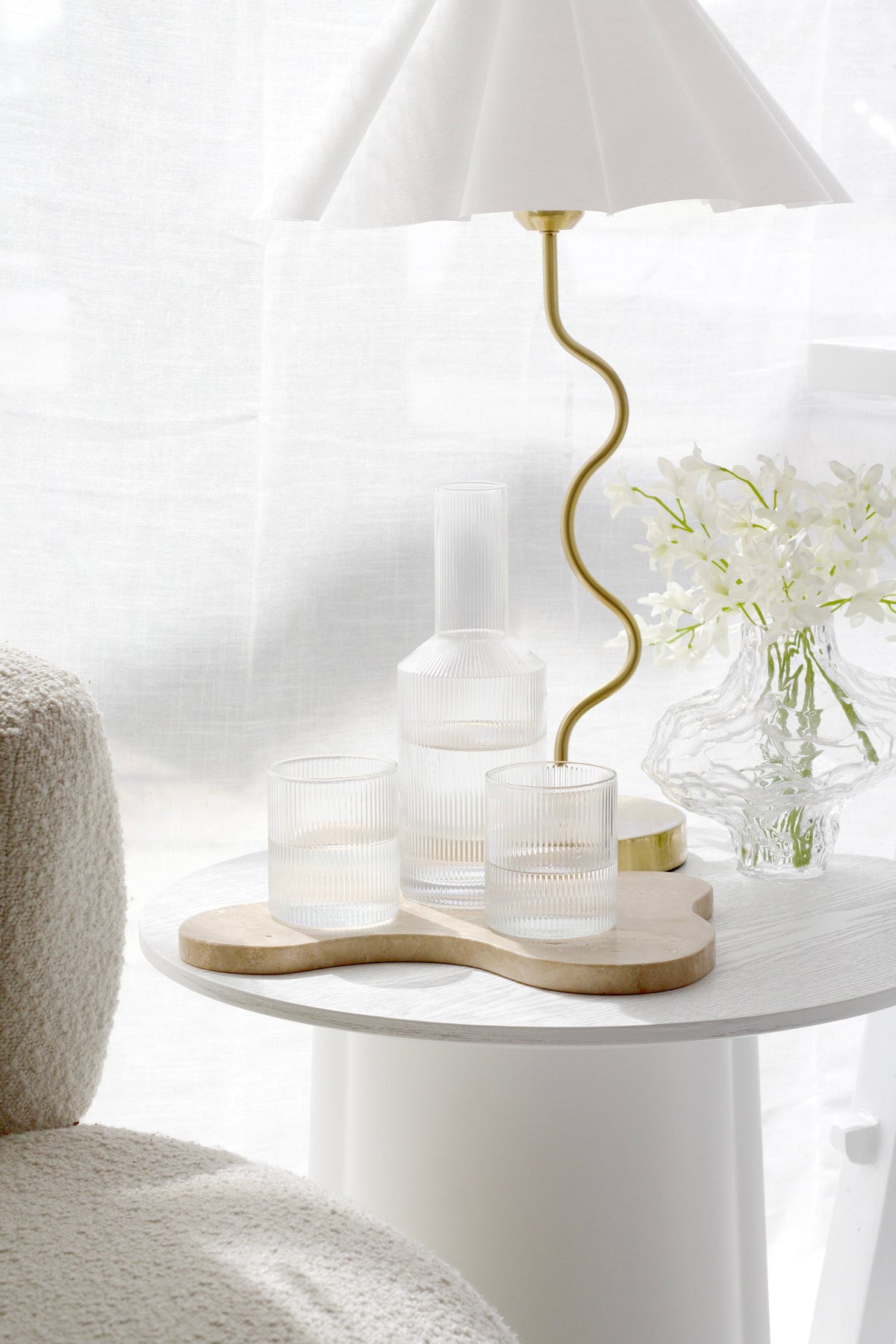
Use woven or perforated lampshades so artificial light throws a delicate pattern onto walls at night.
 Architects and theorists often remind us that shadow is not the enemy of light; it’s what gives light depth. Pallasmaa writes that it is precisely these subtle shadows and dim zones that awaken our senses and imagination.
Styling organic shapes like our curved vases, candle holders and faux foliage stems in these zones enhances the effect. The shadows around them deepen and soften as the light moves.
4. Choose Materials for How They Behave in Light
Don’t just ask, “Do I like this colour?” Ask, “What does this surface do when the light changes?” Good choices:
-
Walls in complex neutrals that shift slightly between morning and evening
-
Matte or honed finishes that glow rather than glare
-
Light timbers and natural fibres (linen, cotton, wool) that come alive in side light
 Zumthor talks about how the light on things tells us as much about a building as its form: the way a surface “dulls or sparkles or has its own depth” becomes part of the atmosphere we feel.
Even small pieces (a matte ceramic tray, a ribbed vase, a linen cushion from our soft furnishings collection) can dramatically change how light reads in a corner.
5. Use Light to Set the Emotional Rhythm of the Day
Lighting is one of your strongest tools for shaping how a home feels from morning to night.
Morning: soft natural light, sheers, perhaps a single lamp on near where you journal or drink coffee. A quiet vignette with a mug, a journal, and a bud vase can become the anchor for that ritual.
 Daytime: bright but diffuse light in work or study areas; minimal glare, clear surfaces. A simple desk styled with a pen pot, a small plant and a minimal lamp from our lighting collection feels calm and ready.
Evening: shift from overheads to lamps, wall lights and candles. Warm pool lighting around the sofa, dining table or reading chair, plus layered fragrance and texture from our candles, room sprays, cushions and throws, helps the body register: we’re winding down now.
 Night: low, warm points of light: a bedside lamp, a hallway night light, a single candle on a bedside tray. Just enough to feel safe, not so much that the room wakes up again.
You’re essentially giving your home a light choreography that matches how you want your days to feel, what Louis Kahn might call the meeting of the “measurable” (fittings, circuits, lumens) and the “immeasurable” (atmosphere, presence, feeling).
6. Design Little “Light Glimmers”

“Glimmers” are tiny cues of safety and joy. You can design for them.
Think:
A chair that always catches the 4pm sun.
A small console where late afternoon light hits a glass vase and a framed print, creating a repeating little light show.
A corner of the bedroom where a lamp, a ceramic tray, a single stem in a bud vase and a candle gather into a warm glow every evening.
These aren’t grand gestures. They’re small, repeatable moments you come to look forward to. Over time, they become part of how your home looks after you.
In architectural language, you’re creating a series of micro-atmospheres, small pockets of space where light, material and memory meet and the room feels more intensely itself.
The Quiet Power of Designing With Light
A deep fascination with light, especially refraction, reflection, shimmer and dapple, isn’t random. It usually points to:
-
A sensitive, perceptive way of seeing
-
A love of nuance and in-between spaces
-
An intuitive sense that light can be both beautiful and calming
 When we take that seriously in design, we stop asking only:
“Is this room bright?”
and start asking:
“What stories does light tell in here?”
“Where does it soften, break, glow and dance?”
“How can a few well-chosen pieces (mirrors, glass, trays, candles, textiles) help this space hold the light more beautifully?”
 You don’t need to rebuild your house to begin. Often, the first step is as simple as noticing where the nicest light already falls, and placing a mirror, a vase, a tray or a candle from our collections right there, so the light has something to play with.
From there, your home slowly becomes what it’s always had the potential to be:
a living conversation between light, matter and the humans who call it home, with a quiet chorus of architects and theorists, from Le Corbusier to Pallasmaa and Zumthor, nodding along in the background.





Leave a comment
This site is protected by hCaptcha and the hCaptcha Privacy Policy and Terms of Service apply.